I was working on a data analytics project, and I have something worthwhile to share with my fellow data enthusiasts. The question being addressed was:
i. Does contract type affect churn?
I was using Telecom dataset to provide solutions to imminent problems in the company.
So, here, we are dealing with two columns, ‘Contract’ and ‘Churn1.’ Churn1 is a result of converting the ‘Yes’ and ‘No’ values in the original column ‘Churn’ to ‘1s’ and ‘0s’, a process known as feature engineering. This was to have numerical data to work with.
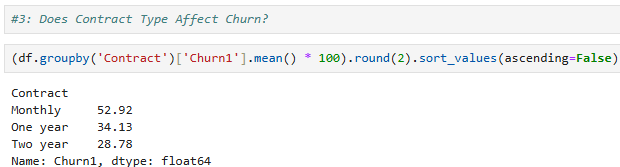
Now, to aggregate the contract types and find those that positively affected Churn, I used the following python code:
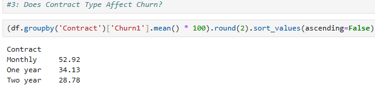
Fig 1: Python Code for Churn Rate and Contract Type
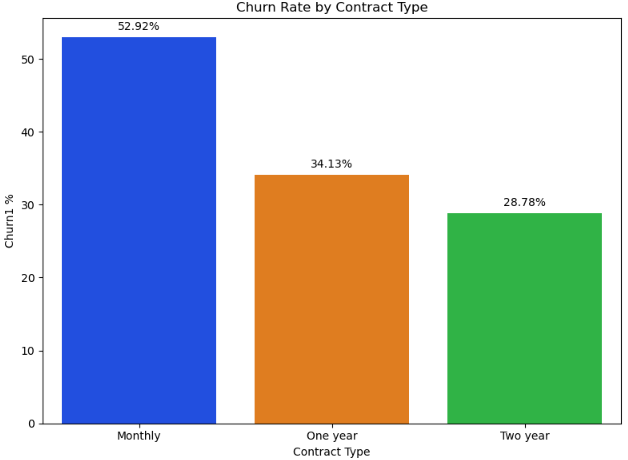
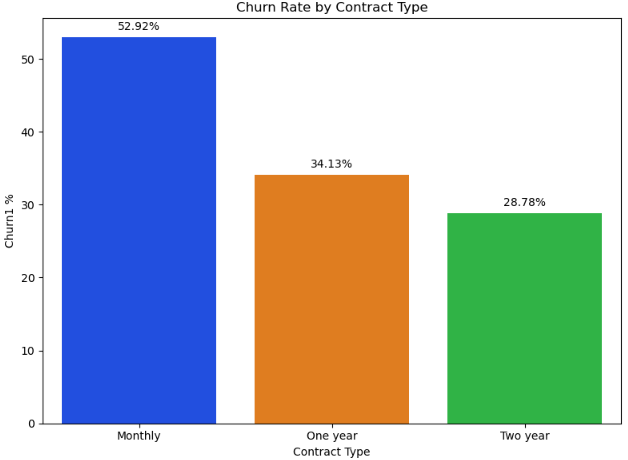
When visualized, the chart appears as follows:
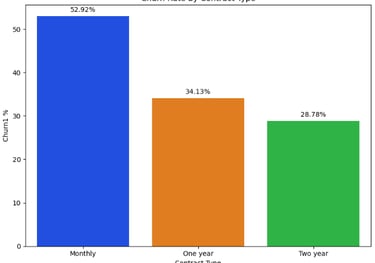
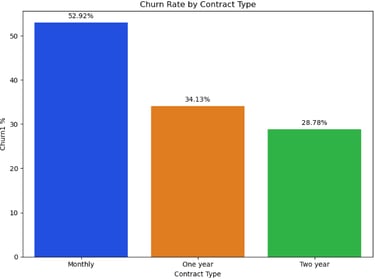
Fig. 2: Bar Plot on Churn Rate by Contract Type
As you can see: the shorter the contract period, the higher the churn rate. This means that higher contract period customers experience the lowest churn rate. This information is true to many businesses and signifies the following:
1. Longer term contract customers are more valuable to the company
2. Strategies to attract more long term contract customers or even to convince the shorter term ones to opt in to longer periods should be implemented. An example is reducing prices for one and two year contracts.
3. Still, strategies to keep Monthly contract customers should be implemented as well, such as offering random prizes.
These are actionable insights that the business can work on to stabilize its operations, raise retention, sales, revenues, and finally boost profitability.
So, the next time you are working on a data analytics project, go past the visualization to tie its implications to the business problem. Data Analysis is all about problem solving.
By: Boniface Mibei
BK Data Analytics